9 March 2014

300: Rise of an Empire - Film

300: Rise of an Empire starts where the last film left off; the King Leonidas and the 300 Spartans have fallen, and the Persian army are still invading. The widow, Queen Gorgo (Lena Headley), tells us the story of the General Thermosticles (Sullivan Stapleton) at the battle of Marathon, where he shot an arrow into the Persian ruler, King Darius, as his son watched. Then the story changes direction as we jump to a time before the 300 died, when Thermosticles is trying to unite Greece to fight the Persians but to no avail. What follows is the story of the battle of Salamis, where Thermosticles is pitted against the beautiful Commander Artemisia (Eva Green) in a bid to keep Greece's freedom.

As you might expect from the second film in the 300 franchise, there is a lot of blood and gore, and a lot of fighting, therefore if you don't like action sequences and faint at the sight of blood, you should definitely not watch this film. If you're watching this in 3D, watch out, because the blood gets literally everywhere, including all over the screen in the first action sequence. After the battle of Marathon is over, the 3D element calms down somewhat, and we get on with the main plot.

The plot is actually quite good, as it is based on real life events, if rather embellished. The way that the film shows you character's back-stories and manages to incorporate them into the plot is very nicely done, and the story flows very well from one element to the next. Of course, the main focus is on the battles, and therefore a lot of the plot is lost amongst all the fighting scenes. One impressive thing is the manner that people die, and you can't help but wonder at the inventiveness of the people who thought them up; one man gets his head smashed in by a horse, another simply gets his head cut off in two simple knife strokes. As stated before, there is an abnormal amount of blood in these scenes, try not to be sick.

As for the acting, although we have suffered the blow of having Gerard Butler's character die, we still get the acting talent of Lena Headley, Rodrigo Santoro and David Wenham, but with the added bonus of Eva Green, who is a very welcome addition. You may also recognise Jack O'Connell (Skins) and Hans Matheson (The Tudors, Les Miserables). The main character, Thermosticles, is quite well played, but given that he seems to have only one driving force, he ends up being a very one-dimensional character and so I doubt Sullivan Stapleton could have done much more to save him from scrutiny. Really, the star of the show was always going to be Eva Green, whose character is interesting, lively and reasonably multi-faceted.

One thing that was particularly stunning about the film was actually the special effects and the costumes. The beauty of the landscape and the attention to detail in the naval ships, the flowing cloaks and the spraying blood was quite acute. Eva Green's ensembles were always flawless; a perfect mix of femininity and harshness that suited her character very well.

This film, although a gorefest and a standard action-type plot, was visually stunning (in a macabre sort of way) and strangely enjoyable to watch when you want a slightly less intellectual film. The history is artfully twisted into a story that turns out to be quite watchable. On that note, it gets a 6 out of 10, and it may even get a second watch.

geekexchange

8 March 2014

Bitter Greens - Kate Forsyth

It's time to take another look at yet another fairytale retelling. This time, Rapunzel gets a makeover, and this time there are three tales woven into the plot. The first is that of Charlotte-Rose de la Force, a French writer with an extraordinary life, exiled to a nunnery by King Louis, the second is that of Selena Leonelli, an Italian courtesan, muse to a great painter but frightened that time will take away her beauty, and the third is our Rapunzel, Margherita, a young girl taken from her family by a witch and forced to live her life in a tower with dark secrets within.

So far, so good; this book manages to combine three very well-written characters and make the story something extremely interesting. The only downside was that it starts with Charlotte-Rose's going to the nunnery and her first impressions on being there. It then tells the story of a woman who falls in love with a man and makes him fall in love with her through the help of a witch. As of yet, there is no sign of this being the story of Rapunzel, and that it where the book lets you down. The story that you would buy the book for only really gets going when you are half-way through the book. Instead, we have several strands of the story, seemingly nothing to do with each-other, and the backgrounds of characters that you never see again, such as Margherita's mother. However, once you do complete the book, you find that all of this was valuable information contributing to the character and the final few chapters, where all this comes nicely into place.

Therefore, I am unsure as to whether I liked this book or not. When I finally did get to the middle of the book, I was completely wrapped up in the story, about what happens to Selena Leonelli and Margherita, and how Margherita comes to be the witch's undoing. Also, I felt the big reveal was rather easy to decipher, as I was quite sure of the twist from the moment I began reading about the witch.

I did like the way that this story was woven in with reality so that it could be believed that all of the story were real events that have been told so many times that they have become fairytales. It is a lovely idea, and one that I enjoy seeing in many of the fairytale retellings I have read, most notably in Confessions of an Evil Stepsister, by Gregory Maguire. This brings me on nicely to the fact that it included the French court of Louis XIV, and Charlotte-Rose, which steeped the story in a lovely account of a part of  history that I have not previously been exposed to.

This is certainly a Rapunzel for grown-ups, there are some quite disturbing scenes, as well as very sexual ones that a child should not be reading. The themes are also quite adult; there is so much about death, despair, anger and politics. However, along with that comes a fervour for love conquering all and a good dose of magic, though I believe that it could easily be interpreted as plain science in today's world.

I am giving this book a 7 out of 10, simply for the fact that it did not get fully into the story for some way.


6 March 2014

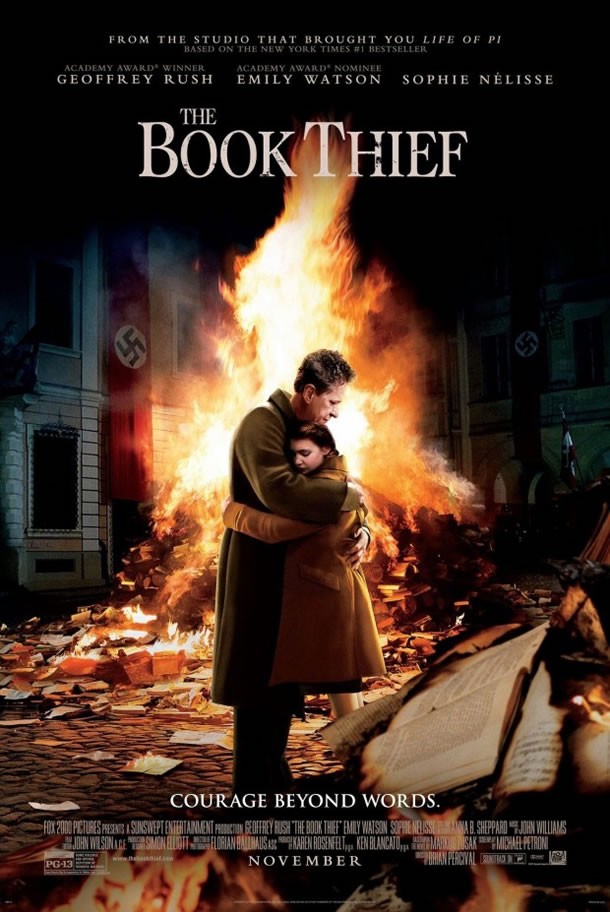
The Book Thief - Film

I am a huge fan of this book. I bought it years ago and it quickly became one of my favourites, so there will be many, many allusions to the book in this post.

The story sets up the premise straight away; this will not be a completely happy story, because the first voice you hear is death's, and the first scene you see, and little boy dies. From then on we follow the story of his sister, Liesel Meminger, as she is given up by their mother to live with the Hubermann's, who will be her foster parents in Germany; the thundercloud that is Rosa, and the kindly soul that is Hans. Liesel isn't very good at making friends, but she soon discovers a bond with her foster father; they both like to learn and to read stories, and, although she never meant to, she begins to steal books to feed this enthusiasm. But this is wartime Germany, and Jewish people are being threatened by the Nazi party. The Hubermann's are Jewish sympathisers, and when a young man with a connection to Hans comes to their doorstep, they hide him in their house for as long as they can.

So the main thing that really stands out in the book is the idea of death as the narrator. In the book, death tells the story of how he came to be haunted by Liesel Memminger, and it all started with a white death. The next time he saw her, the world was red, and the last time was black, three colours that were never even mentioned in the film, yet I felt they were very significant in terms of imagery. It was nice to see that the first scene was quite startling white, but it was a shame the colours were not carried through to the rest of the book.

The second thing that stands out is the period that this film is set in; Nazi Germany, and the fact that the main characters are hiding a Jew in their basement is truly compelling. The film tells this story very well, with a real sense of the friendship that develops between Max and the family, most of all with Liesel. It also shows the fear and the effect that the party had on the community, with many people being afraid of having a Jewish-sounding name, or of fraternising with sympathisers. The absolute humanity in the film is excellent, and I loved the way that relationships developed within the plot.

The acting is one thing that is both good and bad; Geoffrey Rush and Emily Watson are truly incredible in their parts, but for me the main character, Liesel, didn't really match up. Maybe it was the fact that Liesel, as a character, isn't particularly talkative, and is quite a normal girl, despite all her bravery and her thievery. The last scene in the book, for me, was hugely emotional, and yet that emotion did not translate into the film. Instead, we saw death and destruction, but it was all muted, and it gave way into a conclusion that was quite bland, compared to the ending that death gives in the book.

Overall, the film is very good, and if you have not read the book, it will make you want to read it. It is ideal for people who enjoy films that have a historical background and human interest, for example; The Help, The King's Speech, Pan's Labyrinth (highly recommended) or, The Boy in the Striped Pajamas or Schindler's List. 8 out of 10.


16 February 2014

Daughter of Smoke and Bone - Laini Taylor

Karou is a 17-year-old art student living in Prague, but she is also an errand-girl for a monstrous chimaera named Brimstone, who collects teeth for a living. For the past 17 years, her two lives have been balanced between normality and teeth, but now Brimstone is sending her on more errands than ever, and the doors to his shop, to a place between two worlds, are being marked by beautiful humans with winged shadows. Lying at the heart of all this is a dark secret, and Karou is about to find out exactly what it is, and why she has everything to do with it.

This third-person narrative centres wholly around Karou, our protagonist. We find out everything as she does, and wow, is there a lot of suspense because of that. The best part about the reveal is that you really are not expecting the truth, and when it comes, there is a wealth of information, not to mention a whole storyline we were previously only dipped in and out of. While you may have a vague sense of the truth, the reality is so much more complex than you would have expected, and it ties up all the loose ends exquisitely.

Character-wise, Karou is extremely likeable, and so is her tiny friend Zuzanna. Akira, the male lead in the story, takes much, much longer to accept, and even now I am unsure if I am totally on his side. The same can be said for Brimstone, but there may be a lot more to learn about this character.

The book is rich in its' description and in terms of depth. Truly, I do not think I have read a better reveal. However, on that point I have to admit it is a really a book of two halves. The beginning is quite slow to start, with everyday cares and not a lot of action, then it builds up in suspense and action until the second half, where the plot barely moves at all. Instead, it provides an enormous flashback into the past of the characters. While the construction of the book utterly makes sense, you can't help want the present to have pushed on more than it did, especially in terms of Karou's feelings. Luckily, the second book, Days of Blood and Starlight, is out now, so we can carry on reading. I am expecting a lot more action and a lot more present storyline in this next book.

All in all, it is a very enjoyable, fantastical and beautiful read that will keep hope alive in all of us. Young Adults will love it for the sheer imagination of the ideas and for the wonderful way that love, hope and war coalesce in the story. 9 out of 10.


PS: All the covers are awesome for this, but I'm using the UK ones to show you. And I added the Novella at the end too because the cover is lovely.

15 February 2014

Shades of Milk and Honey - Mary Robinette Kowal

Jane is a plain country lady with an extraordinary talent; she can work magic. She can create images and effects by folding a kind of magical tapestry, she just picks up a thread from the ether and works it into reality. Her sister, Melody, is beautiful but not nearly so talented in the use of glamour, instead of working on herself she spends her time chasing men. Everything is as normal until the roguish Captain Livingston arrives, along with the mysterious famous Glamourist, Mr Vincent, whose work captivates Jane,

If you love Jane Austen, you'll appreciate this slightly magical take on the Regency world. There are so many likenesses between this book and Austen's work, such as the two sisters being quite like Elinor and Marianne from Sense and Sensibility, brooding male leads, handsome captains and the inevitable scandal. A fair bit has been taken from Pride and Prejudice, with the most striking one being Jane's parents being a lot like the Bennets in terms of character.

The story, if you have read books or watched film adaptations of Austen's works, is actually fairly predictable, especially once you realise how similar it is to Pride and Prejudice. And it is fair to say that if you were to compare the dimensions of each character, you would find that Austen's are more developed. However, it is a small book, and no doubt the characters you would want to know more about will be discussed in other Glamourist Histories. Despite this, the book is a quick and enjoyable read. The talk of glamour as such a commonplace thing is very interesting to read, and the way it has filtered into normal life is nice. It does not change their lives as much as it could have, but there is something good about the fact that the author has not differed too much from the regency setting, otherwise there might be no point in setting it there.

As for the characters, Jane and Mr Vincent were drawn very well, particularly our heroine, who was everything a good Austen protagonist should be. However, I would like to know more about Mr Vincent's life, and I thought that their romance was rushed nearing the end of the book, as if she suddenly liked him. There also is no description of Mr Vincent; something I would have liked as it was difficult to imagine him. Melody, the Ellsworths and the Dunkirks are all well-drawn, however, more description would have been a good addition.

As to the story, it didn't take long to get into it, and although some parts were slow, it kept a good pace throughout. The climax was really good and very exciting, with the plot seeming to propel the reader closer and closer to finale. At this point you cannot stop reading and was quite unlike any Austen novel, despite the fact that the circumstances that it arrived in were extremely similar.

This story is a fresh take on a classic style of literature, it is light, magical reading and is a great way to introduce teenagers to Regency and Austen. 8 out of 10.