4 April 2012

Divergent - Veronica Roth

Tris lives in a world where you get to choose how you live your life. There are 5 factions - Amity, Abnegation, Candor, Erudite and Dauntless. Each citizen chooses theirs when they are 16. after that, they belong to that faction for the rest of their lives. But what happens if you don't slot neatly into one faction; what if you are divergent?

Dystopian fiction for teens is bang on trend at the moment, thanks to the huge success of 'The Hunger Games'. And this book doesn't disappoint, even for an adult reader. The plot isn't all that twisty and can be obvious to an adult reader, but the depiction of this interesting dystopian concept is excellent. The plot, at times, can be a little cliche - this genre and romance seem to go hand in hand - but overall it is a thrilling, fast-paced read. The events culminate to an unexpectedly huge crescendo, and I wonder how the next novel will fare after that. One possible question that may remain in the reader's mind is exactly how the world came into being. Hopefully, an explanation will be given to us in the sequel.

While the novel does not compete with 'The Hunger Games' in terms of technical skill, it has many features that make it well worth the read:-

The characters are believable, likeable and realistic to their world. This, I think, can be see very well in Roth's protagonist, but also in her other characters. For example Albert, another initiate, is torn between a crush on a girl and the will to survive the initiations (or risk being factionless and living on the edge of society). I think it is good that they don't act or think exactly as we do, otherwise they wouldn't feel right to the reader.

It also really makes you think about yourself as a person. If you were in this world, which faction would you belong to? Would you also be divergent? Or would you choose to be factionless? There are tests in the book that you can place yourself into and decide how you would fare in that world - your capacity for selflessness, or your deepest fears.

Overall, I give it a 9/10. Not perfect, but definitely getting there.

The second novel, Insurgent, comes out on hardback on the 1st May 2012.

22 March 2012

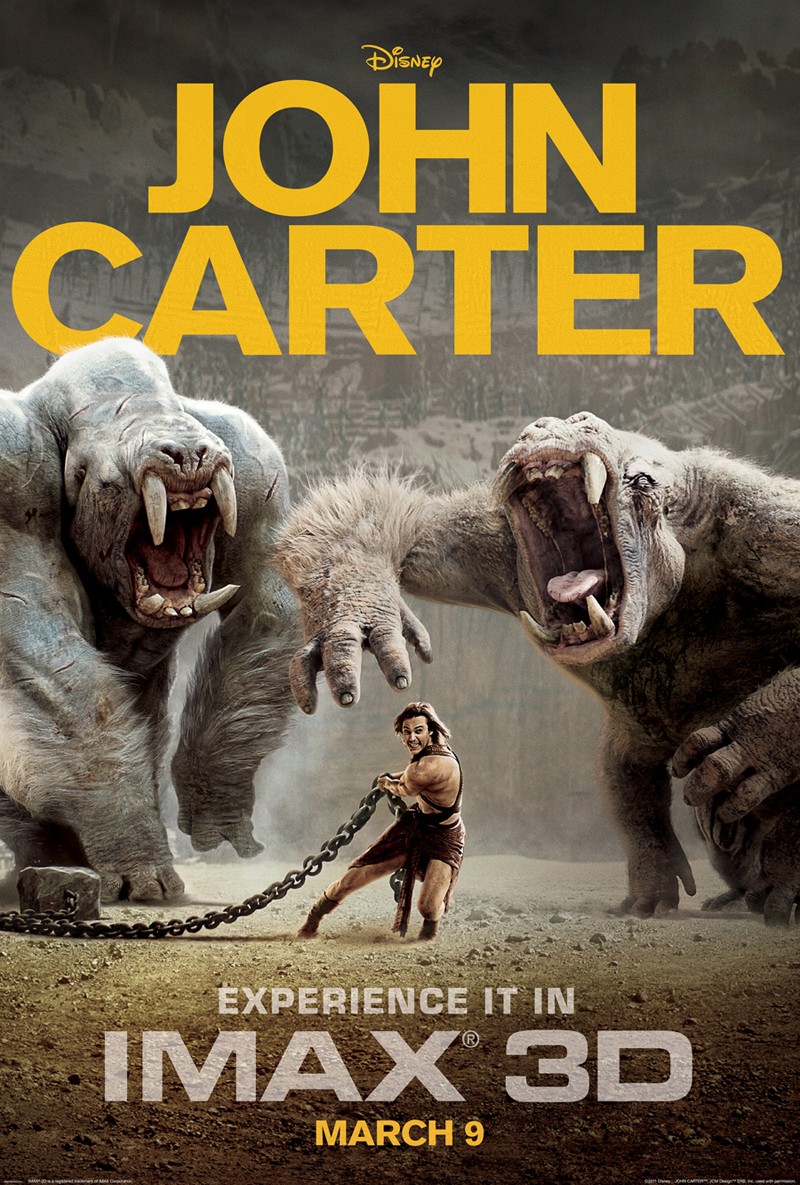
John Carter

John Carter is an explorer searching for a cave of gold, but he gets way more than he bargains for as he travels over to Mars and becomes involved in the politics and struggles that the inhabitants face.

The film is derived from a set of magazine serials and novels (called Barsoom) by Edgar Rice Boroughs, which date all the way back to 1912, so the concept is a very old one. There have been various comic book adaptations of the stories and in 2009 the first novel, a Princess of Mars, was released as a direct-to video film.

The film may be likened to Avatar in the way that it is set on another planet, but I can safely say that apart from that, I haven't seen anything similar to it before. The concept of a human being travelling to other planets has been done, yes, but has Dr Who ever saved a Princess from an evil man with a blue glowing hand? I think not.

The plot is difficult to explain, as it has many facets that need to be looked at. First, there is the character of John Carter himself. All he wants to do is get home to begin with, but as he gets to know the inhabitants of the planet, and the danger they face, he feels such a connection with them that the need to go home vanishes. The indigenous tribe (four-limbed, big green martians with tusks) are savage and their tempers are brittle, yet John finds some hope that there is more to them than their savage behaviour lets on. There is also a humanoid species living on Barsoom, and that's where all the trouble lies. One man has declared war on the planet, and because of him, it is dying. The Princess of Helium has run away after spurning his marriage proposal, and the hunt is on to catch her again.

But there's much more to it, and it is truly incredible that they have managed to make a film in which it is all explained and nothing is vague. The film has the odd bit of humour too, mainly at the beginning as it becomes more and more serious as the situation progresses. The style of the landscape and the presentation of the characters is very similar to that of 10,000 BC.

And I have to say that the acting isn't too shabby either. I think the most impressive was Lynn Collins (who you may recognise from X Men Origins: Wolverine) whose acting was completely realistic and whose prescence as sceen-stealing. A fun fact for you is that Taylor Kitsch, who plays John Carter, was also in X Men Origins:Wolverine as Remy LeBeau, otherwise known as Gambit.

The cast contains a bucket load of good actors: Mark Strong, Samantha Morton, Willem Dafoe, Thomas Haden Church, Ciaran Hinds, Dominic West and James Purefoy to name a few. I think the best idea of this film is that it is filled with well-known actors and actresses, and yet they aren't main characters. The way Disney does this with their films means that lesser known actors and actresses get their limelight, and something might come of it.

Disney has had a huge hit with Pirates of the Caribbean, we can't forget the visual perfection of Tron:Legacy or the thrilling action sequences from Prince of Persia : Sands of Time, but will this be a hit? We can only wait and see...

8 out of 10

16 March 2012

The Forgotten Legion Chronicles - Ben Kane

Fast-paced, action-packed and truly realistic. This is all the acclaim these books deserve.

The trilogy is set in Italy, when the Romans were at the height of their power and Caesar was cutting down his enemy one country at a time. But we don't follow Caesar. We follow four characters whose backgrounds are far more lowly than a noble. There's Tarquinius, the soothsayer, Brennus, a huge Gaul, Romulus and Fabiola, the twins whose lives were torn apart by their owner.

The story is very real, considering it is set in a time that was so long ago. The attention to detail is meticulous and the amount of research that must have gone into the trilogy is insane! The characters are perfectly defined. They aren't one-dimensional, and they all have different ideas, beliefs, goals and backgrounds. But the best thing about the way the characters are developed in the books is that they each have faults. They aren't your usual perfect beings, and some of them aren't the type that can even be lovable because of them.

The story is engrossing. I admit that the first book took a while to get rolling, as some books will. But I think that this was OK. Without the back-stories, the characters would be nothing more than the purposeless personalities you see in modern teen romance novels. Luckily, Ben Kane is not your average writer. And not only that, but these novels are set in a time when nothing is easy, and nothing is taken for granted. You won't see any star-crossed lovers here.

All three books take place over a good few years. The politics around Rome are continually changing during this time and I really commend Ben Kane for putting it across in a way that is easy to grasp. There's even a glossary of terms in the back for when you just can't remember what a contubernium is. Expect a lot of fighting, blood and sexual content. After all, this is Ancient Rome in a time of confusion and continual war.

So if you like your history, or just like reading about epic journeys, destiny and intrigue, this is the book for you.

It truly engrossed me.
Five out of five

The books go in the order: The Forgotten Legion, The Silver Eagle, The Road to Rome
Buy them: Right Here

5 January 2012

Rivers of London - Ben Aaronovitch

Have you ever wondered what would happen if the Metropolitan Police had to deal with the supernatural? Well, now your pondering has come to fruition. Aaronovitch manages to combine the reality of being a Police officer in modern-day London with some rather ghostly happenings.

Junior Constable Peter Grant is guarding a crime scene in the early hours of the morning when he finds a witness to the crime. There's just one little problem. His witness is a ghost, and his story doesn't make any sense. Read on a few pages and you'll be hooked on the mystery of how on earth someone can manage to knock someones head clean off.

If you thought that this was just another Harry Potter, think again. Whilst this is admittedly set in a real world where magic is hidden away from the public and the main character does become a wizard (well, an apprentice), it is definitely an adult book. Sexuality and goriness are rife here, and there is even a bit of explanation to the magic.

This book is for people who love the sci-fi and fantasy genres, but yearn for something witty and (fairly) realistic. But really, I think anyone could read it.

10/10.

I don't think I could have asked for a more entertaining read.


PS: Look out for the sequel: Moon Over Soho

5 September 2011

Reckless - Cornelia Funke

Following her extremely popular Inkheart series (also made into a film starring Brendan Frasier), Cornelia Funke comes up with another insightful take on the adult fairy tale. Drawing from classic tales such as 'Through the Looking Glass', 'Sleeping Beauty' and 'Rapunzel' as well as various other fairy tales, this story is fast paced and enchanting.

Jacob Reckless has been going through the mirror for years. He knows the world behind it almost better than his own - he even calls it home. But now everything has changed. His brother has followed him though and has been clawed by a ferocious Goyl, whose stony skinned race are slowly taking over the land. Jacob will try anything to save his brother, but this world isn't making it easy.

This book is reminiscent of a few other writers works who have tried their own interpretations of fairy tales. Perhaps the most notable is John Connoly's The Book of Lost Things, whose world is also riddled with elements of fairy tales. Another notable writer is Gregory Maguire, whose retelling of The Wizard of Oz (Wicked) has been made into a successful theatre production.

However, this story has become its own with the great imagination of its author, who dreams up entire underground cities, as well as creature species and interesting characters. The fairy tales are entwined into it with sophistication and newer, scarier ones are told in their stead. Knife-fingered men lurk in the forests, ready to make your skin into clothing. Gingerbread houses are so alluring they lull their trespassers into a soothing sleep, locking the gate behind them.

The plot is a great credit to Cornelia Funke, as many fairytale based stories can get too lost in their original forms. Here, she creates a set of entirely new heroes and villains to build her world around, and includes a rather good political plot as well as a few good twists. The characters, who are altogether very good, may not be entirely relatable. Jacob, for example, is rather aloof to begin with, which may cause the reader to warm to him less.

The story is centred around the themes of love - in a familial, friendly and romantic sense - and gives the reader a heartwarming idea of how the characters interest and feel about each other. The style is easy to read, almost too easy, as it is difficult to put it down.

It is clear that the book was meant for a teen and adult audience who are more than familiar with the fantasy and fairy tale genres. If this sounds like you, then this book will be just the thing you may be looking for. It deserves a 9 out of 10.


The sequel, Fearless, is out in 2013.