5 April 2012

Brave New World - Aldous Huxley

"O wonder!
How many goodly creatures are there here!
How beauteous mankind is! O brave new world
That has such people in't!"

                      - Miranda, The Tempest

This book, which was first published in 1932, would spark the tide of dystopian literature that followed in eras that, let's face it, weren't too happy with life in general.

What we need to remember, when reading this classic, is that some of the concepts that are included hadn't even been invented yet. It was first found that hormones could control ovulation in the 30s, but the first oral contraceptive was first introduced to the public in the 60s, a good 30 years after the book was finished. Huxley was writing about things that may seem to be old to us, but at the time they were new, exciting and radical ideas.

The story is based in a futuristic Britain, where cities, towns, even villages comprise of multistory buildings. Where Soma, a drug with no bad side effects, makes everyone happy. Where babies are mass produced from tubes and everybody belongs to everybody else. And the way the whole society is put together is simply fascinating. The babies are divided into their social classes as soon as they are conceived, and are conditioned to fit in to them perfectly. Some will have alcohol in their blood surrogate, some may be deprived of nutrients at a certain stage of their development.This is all totally normal. And necessary for a fully functioning and happy community. Because after all, if an Epsilon had too high an IQ, why on earth would he want to clean for a living?

We have a small group of main characters in the story that round it out nicely for us. We see he world through very different viewpoints; a normal Delta citizen, who is almost perfectly conditioned, an Alpha-plus who isn't happy with the world at all, the boss who keeps the world turning, and the savage- a man from an undisturbed civilisation very similar to that of a Native American tribe, who is brought into the futuristic world.

While the story isn't particularly thrilling for a modern reader, they may be able to gain an insight into Huxley's mind, and what he thought about his own civilisation. The book really makes you think about the power of government control and about how someone from and African tribe, for example, would react to our own civilisation if they had it forced upon them. And the result is rather shocking, I have to say.

I find that the parallels and differences with Shakespeare's 'The Tempest' are extremely interesting. There is a savage who is clearly misunderstood, but instead of forcing him into slavery, the people in the book are fascinated by him and welcome him into their civilisation. The clear references to many of his texts are also interesting. I like the way that the savage uses the quotes as arguments for his own feelings. Huxley must have been extremely moved and must have read Shakespeare avidly to use them so many times within his work.

To conclude, I think that this is a book that is worth reading for those of you who like the genre and want a more adult read than the current dystopian fiction has on offer. The concepts are interesting and the story is good, though not nearly as action-packed as modern books and with a lot more conversation.

Still, I give it a 7/10.

4 April 2012

The Hunger Games (film)

Dystopian novels for teens are definitely trending at the moment, and it's all to do with this gem of a trilogy. Being a huge fan of the genre already (both Adult and YA), I practically swallowed the novels whole. I can safely say that they are fantastic for a person of any age and, somewhat controversially, any gender too.

So, when I heard that the film was coming out, I was worried. Very worried. Hollywood had already crashed and burned all over my beloved 'Northern Lights' - they had created a monster of a film called 'The Golden Compass' in it's place. But, surprisingly, 'The Hunger Games' actually left me with an even clearer message than the books had about reality TV, politics and privacy.

The book follows 16-year-old Katniss Everdeen as she bravely volunteers, in the place of her 12-year-old sister, in the 74th Annual Hunger Games. The film is NOT to be confused with the events of the film Battle Royale, which, although it has a very similar basic idea (ie: children killing each-other), is lacking in any meaning.

What is truly remarkable about this film is that the politics and the main concepts are cleverly depicted in a way that anyone can understand. Even people who have not read the books have come away knowing exactly what was going on. No confusion, just a burning desire to go read the books to find out what happens next. I personally love the way that the 'tracker jackers' have been explained - but you'll have to watch it to know more!

The world itsself has been perfectly realised. It's almost exactly how I imagined it. Readers of the books will be happy to know that the plot is never strayed from, and i believe that some minor discrepancies actually enhance the viewing experience. Plus, it gives those who haven't read it yet a couple of nice surprises. Things I may have wanted to see aren't hugely missed, and things that will turn out to be of importance are put in.

I believe that all the fundamentals of the story are there, as well as parts that I thought were extremely important to put in. There are poignant moments and particular phrases that will really help when making the second, third and fourth films. This may have something to do with the fact that the writer -Suzanne Collins, helped out with writing the film's script, and must have had a very good hold on the production.

I have only one problem. Because the concept is a difficult one, the beginning is somewhat slow. The action doesn't start for a little while, and there is a fair amount of talk. At the very beginning there is a little bit of writing. I advise everyone to read it. If you don't, I guarantee you won't really get the beginning at all. However, don't let that stop you from going. As soon as you get past the blurb, your inquisitiveness gets the better of you and you are catapulted into Panem, the Capitol and The Hunger Games itsself.

The casting was excellent, too. Some fairly well known names like Woody Harrelson, Stanley Tucci, Elizabeth Banks, Toby Jones and Donald Sutherland played fairly integral characters, which was good as support. But virtual unknowns Jennifer Lawrence (X-Men: First Class) and Josh Hutcherson (The Vampires Assistant, Journey to the Centre of the Earth) took the lead roles. And may I say that I think these two are destined for good things. Their acting was extremely good, but I think that Hutcherson just gets my top spot for his perfect portrayal of Peeta Mellark. Oh, and Lenny Kravitz is in it, too, for all you music lovers.

Many have dubbed it 'the next big thing', and while I usually don't like that label, I think that they're right. With a film as consistent as this one I think that 'The Hunger Games' franchise could be as successful as Harry Potter, and, if there is any justice in the world, ten times more successful than Twilight.
It's a 9.5 out of 10.


For an excellent list on Young Adult dystopian fiction, please go to THIS blog post. And there are tonnes more, you just have to search them online.

Divergent - Veronica Roth

Tris lives in a world where you get to choose how you live your life. There are 5 factions - Amity, Abnegation, Candor, Erudite and Dauntless. Each citizen chooses theirs when they are 16. after that, they belong to that faction for the rest of their lives. But what happens if you don't slot neatly into one faction; what if you are divergent?

Dystopian fiction for teens is bang on trend at the moment, thanks to the huge success of 'The Hunger Games'. And this book doesn't disappoint, even for an adult reader. The plot isn't all that twisty and can be obvious to an adult reader, but the depiction of this interesting dystopian concept is excellent. The plot, at times, can be a little cliche - this genre and romance seem to go hand in hand - but overall it is a thrilling, fast-paced read. The events culminate to an unexpectedly huge crescendo, and I wonder how the next novel will fare after that. One possible question that may remain in the reader's mind is exactly how the world came into being. Hopefully, an explanation will be given to us in the sequel.

While the novel does not compete with 'The Hunger Games' in terms of technical skill, it has many features that make it well worth the read:-

The characters are believable, likeable and realistic to their world. This, I think, can be see very well in Roth's protagonist, but also in her other characters. For example Albert, another initiate, is torn between a crush on a girl and the will to survive the initiations (or risk being factionless and living on the edge of society). I think it is good that they don't act or think exactly as we do, otherwise they wouldn't feel right to the reader.

It also really makes you think about yourself as a person. If you were in this world, which faction would you belong to? Would you also be divergent? Or would you choose to be factionless? There are tests in the book that you can place yourself into and decide how you would fare in that world - your capacity for selflessness, or your deepest fears.

Overall, I give it a 9/10. Not perfect, but definitely getting there.

The second novel, Insurgent, comes out on hardback on the 1st May 2012.

22 March 2012

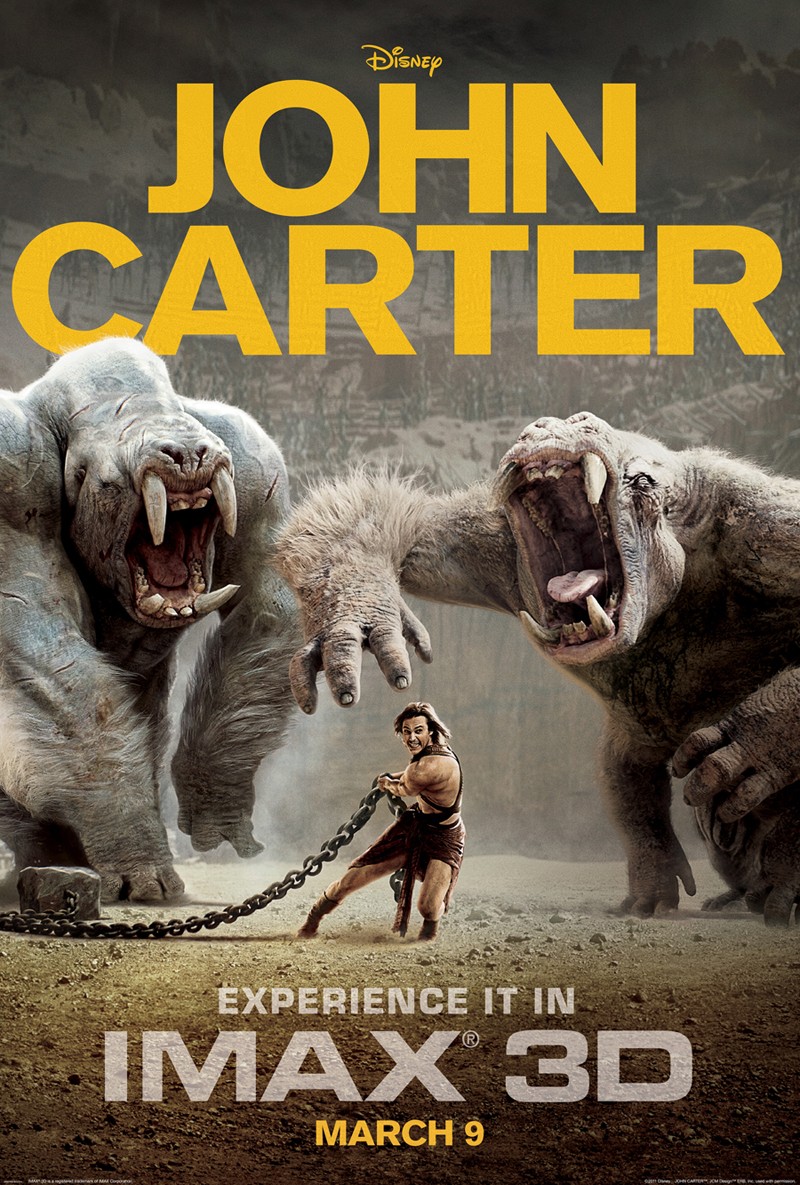
John Carter

John Carter is an explorer searching for a cave of gold, but he gets way more than he bargains for as he travels over to Mars and becomes involved in the politics and struggles that the inhabitants face.

The film is derived from a set of magazine serials and novels (called Barsoom) by Edgar Rice Boroughs, which date all the way back to 1912, so the concept is a very old one. There have been various comic book adaptations of the stories and in 2009 the first novel, a Princess of Mars, was released as a direct-to video film.

The film may be likened to Avatar in the way that it is set on another planet, but I can safely say that apart from that, I haven't seen anything similar to it before. The concept of a human being travelling to other planets has been done, yes, but has Dr Who ever saved a Princess from an evil man with a blue glowing hand? I think not.

The plot is difficult to explain, as it has many facets that need to be looked at. First, there is the character of John Carter himself. All he wants to do is get home to begin with, but as he gets to know the inhabitants of the planet, and the danger they face, he feels such a connection with them that the need to go home vanishes. The indigenous tribe (four-limbed, big green martians with tusks) are savage and their tempers are brittle, yet John finds some hope that there is more to them than their savage behaviour lets on. There is also a humanoid species living on Barsoom, and that's where all the trouble lies. One man has declared war on the planet, and because of him, it is dying. The Princess of Helium has run away after spurning his marriage proposal, and the hunt is on to catch her again.

But there's much more to it, and it is truly incredible that they have managed to make a film in which it is all explained and nothing is vague. The film has the odd bit of humour too, mainly at the beginning as it becomes more and more serious as the situation progresses. The style of the landscape and the presentation of the characters is very similar to that of 10,000 BC.

And I have to say that the acting isn't too shabby either. I think the most impressive was Lynn Collins (who you may recognise from X Men Origins: Wolverine) whose acting was completely realistic and whose prescence as sceen-stealing. A fun fact for you is that Taylor Kitsch, who plays John Carter, was also in X Men Origins:Wolverine as Remy LeBeau, otherwise known as Gambit.

The cast contains a bucket load of good actors: Mark Strong, Samantha Morton, Willem Dafoe, Thomas Haden Church, Ciaran Hinds, Dominic West and James Purefoy to name a few. I think the best idea of this film is that it is filled with well-known actors and actresses, and yet they aren't main characters. The way Disney does this with their films means that lesser known actors and actresses get their limelight, and something might come of it.

Disney has had a huge hit with Pirates of the Caribbean, we can't forget the visual perfection of Tron:Legacy or the thrilling action sequences from Prince of Persia : Sands of Time, but will this be a hit? We can only wait and see...

8 out of 10

16 March 2012

The Forgotten Legion Chronicles - Ben Kane

Fast-paced, action-packed and truly realistic. This is all the acclaim these books deserve.

The trilogy is set in Italy, when the Romans were at the height of their power and Caesar was cutting down his enemy one country at a time. But we don't follow Caesar. We follow four characters whose backgrounds are far more lowly than a noble. There's Tarquinius, the soothsayer, Brennus, a huge Gaul, Romulus and Fabiola, the twins whose lives were torn apart by their owner.

The story is very real, considering it is set in a time that was so long ago. The attention to detail is meticulous and the amount of research that must have gone into the trilogy is insane! The characters are perfectly defined. They aren't one-dimensional, and they all have different ideas, beliefs, goals and backgrounds. But the best thing about the way the characters are developed in the books is that they each have faults. They aren't your usual perfect beings, and some of them aren't the type that can even be lovable because of them.

The story is engrossing. I admit that the first book took a while to get rolling, as some books will. But I think that this was OK. Without the back-stories, the characters would be nothing more than the purposeless personalities you see in modern teen romance novels. Luckily, Ben Kane is not your average writer. And not only that, but these novels are set in a time when nothing is easy, and nothing is taken for granted. You won't see any star-crossed lovers here.

All three books take place over a good few years. The politics around Rome are continually changing during this time and I really commend Ben Kane for putting it across in a way that is easy to grasp. There's even a glossary of terms in the back for when you just can't remember what a contubernium is. Expect a lot of fighting, blood and sexual content. After all, this is Ancient Rome in a time of confusion and continual war.

So if you like your history, or just like reading about epic journeys, destiny and intrigue, this is the book for you.

It truly engrossed me.
Five out of five

The books go in the order: The Forgotten Legion, The Silver Eagle, The Road to Rome
Buy them: Right Here